
Your merchant statement is one of the few bills that comes in every month that you may not take a focused look at. They're the CVS receipt of bills: long, dense, and the number that really matters — your effective rate — is hard to find. And for most restaurants, credit card processing is the third-largest operating expense, behind food and labor, according to the National Restaurant Association. For a bill that important, you should know how to read it and make sure you're not overpaying.
You don't need to understand every line. You need two things: the one number that tells you what you actually pay, and a clear sense of which fees are yours to challenge. Both take about ten minutes to find.
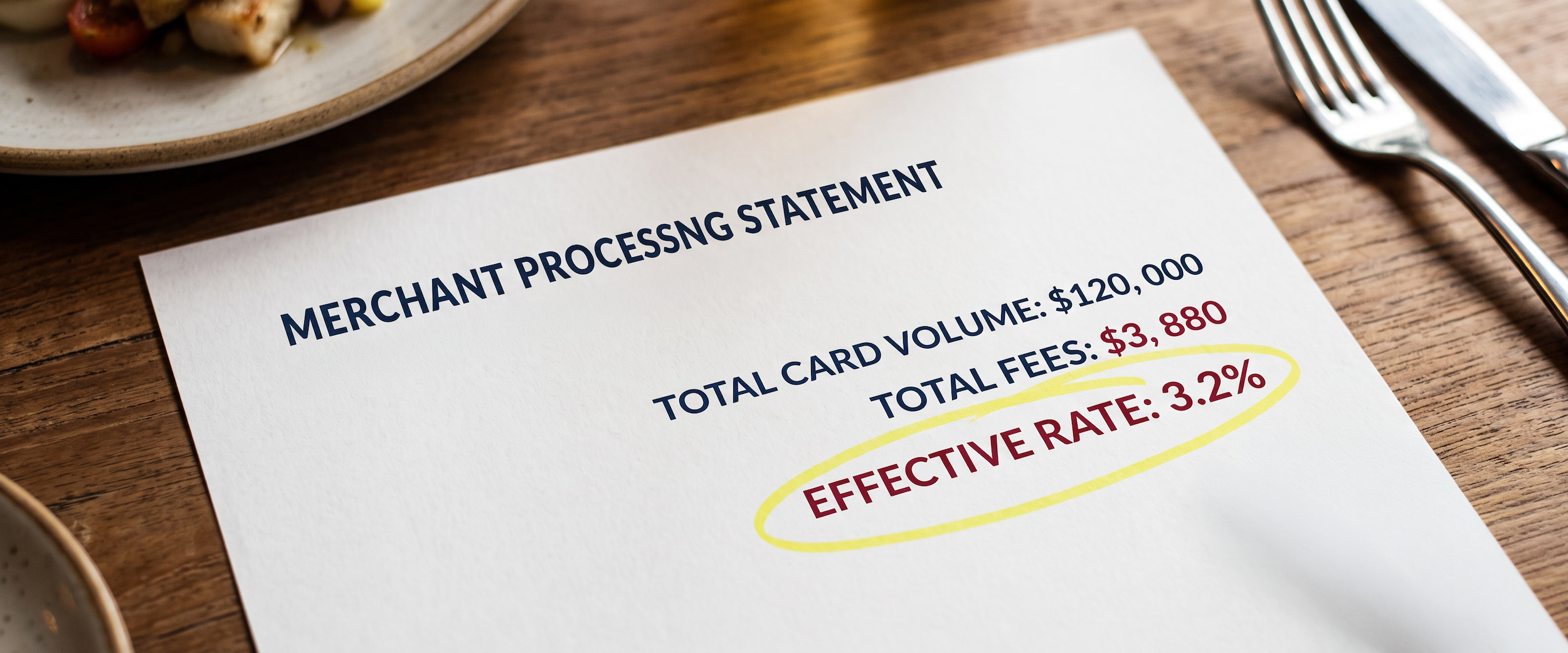
The rate a processor quoted when you signed isn't what you actually pay. Your real cost is your effective rate: every fee on the statement divided by everything you ran through the card reader.
The math is simple:
Total fees ÷ total card volume × 100 = your effective rate.
.png)
Run it on last month's statement. Say you paid $3,880 in total fees on $120,000 in card volume. That's a 3.2% effective rate, whatever the number on your contract says. As a rule of thumb, a restaurant paying north of 3% is probably overpaying, and because it's a percentage of everything you run, a fraction of a point is worth thousands of dollars a year.
This is the first number to get, and it’ll give you an idea whether the rest of the statement is worth a conversation with your processor.
Restaurants are almost always on one of three models, and it’s easy to spot which one you’re on.
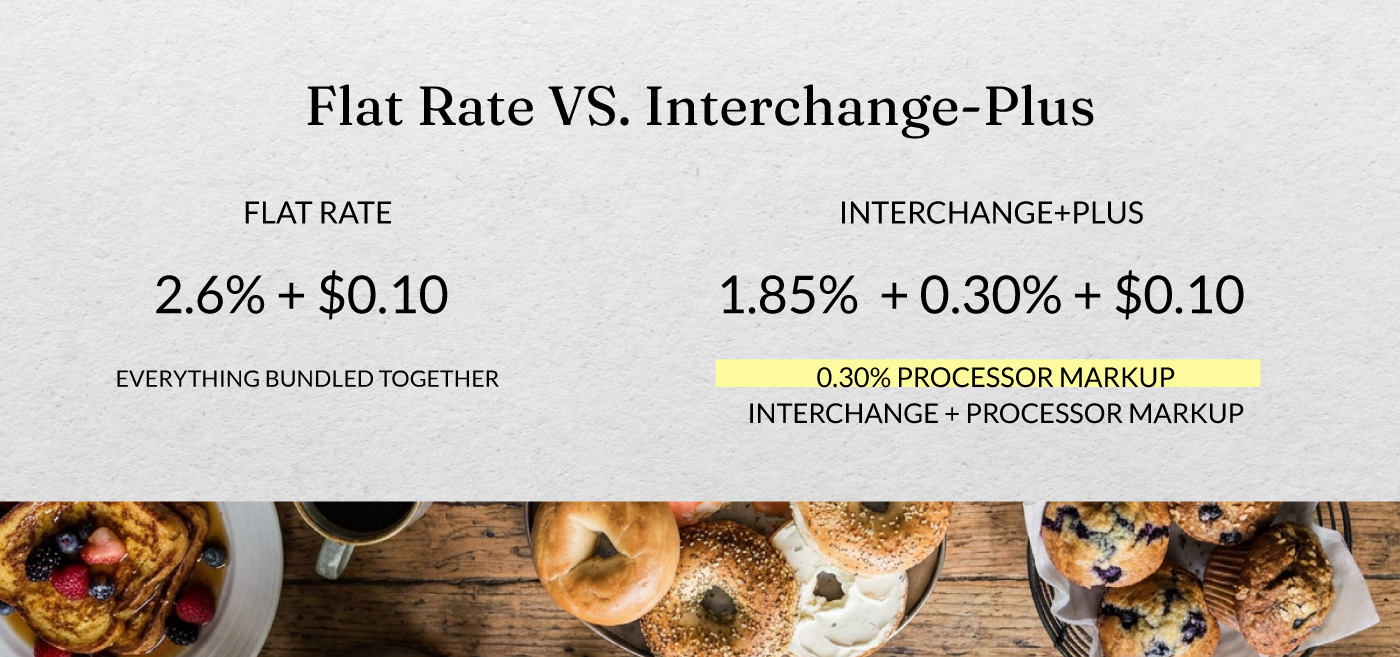
Flat rate blends everything into one number: a percentage plus a per-swipe fee which is the same on every transaction, no matter how big or small.
On your statement, it's one line — something like 2.6% + $0.10 per swipe, no matter the transaction amount. This is usually the thinking behind a card minimum spend at a store.
The appeal is that it’s simple and easy to read. It's also usually the more expensive option once you're doing a lot of volume. The network's cost and the processor's markup are bundled together, with no line showing where one ends and the other begins.
Interchange-plus (IC+) splits the bill in two: the interchange the card networks actually charge, and the processor's markup on top.
The first part is interchange, or the fee the card networks like Visa and Mastercard and your guest's bank charge on every card payment. Every processor pays the same interchange, and none of them can lower it. The second part is the processor's markup: what your processor adds on top for handling the transaction. That's the part you can actually negotiate.
On your statement, the two sit on separate lines — interchange at its own cost (say, 1.85%), then the processor's markup beside it (say, 0.30% + $0.10 per transaction).
The benefit is that you can see exactly what was out of your processor's hands versus what they chose to charge you.
Tiered pricing is the third model, and the one to watch most closely. If your statement sorts transactions into qualified, mid-qualified, and non-qualified, that's the one you're on. Your processor sorts every card payment into one of three buckets and charges a different rate for each:
The rate you were quoted is the qualified one, the lowest. The catch is that the processor decides which transactions land in which bucket, and a lot of everyday business quietly "downgrades" into the pricier tiers: the regular paying with an airline-miles card, a party on a corporate Amex, a phone order you key in by hand. Worse, your statement won't spell out which card brands count as which tier, so the pricier ones are easy to miss. If a quarter or more of your volume is landing in non-qualified, you're paying far more than you probably realize.
The rate you were quoted is the “qualified” one, the lowest. The tricky part is that the processor decides which is which. If a quarter or more of your volume is landing in non-qualified, you're paying far more than you probably realize.
Once you know your model, most of the statement splits cleanly into fees you can't touch and fees worth questioning.
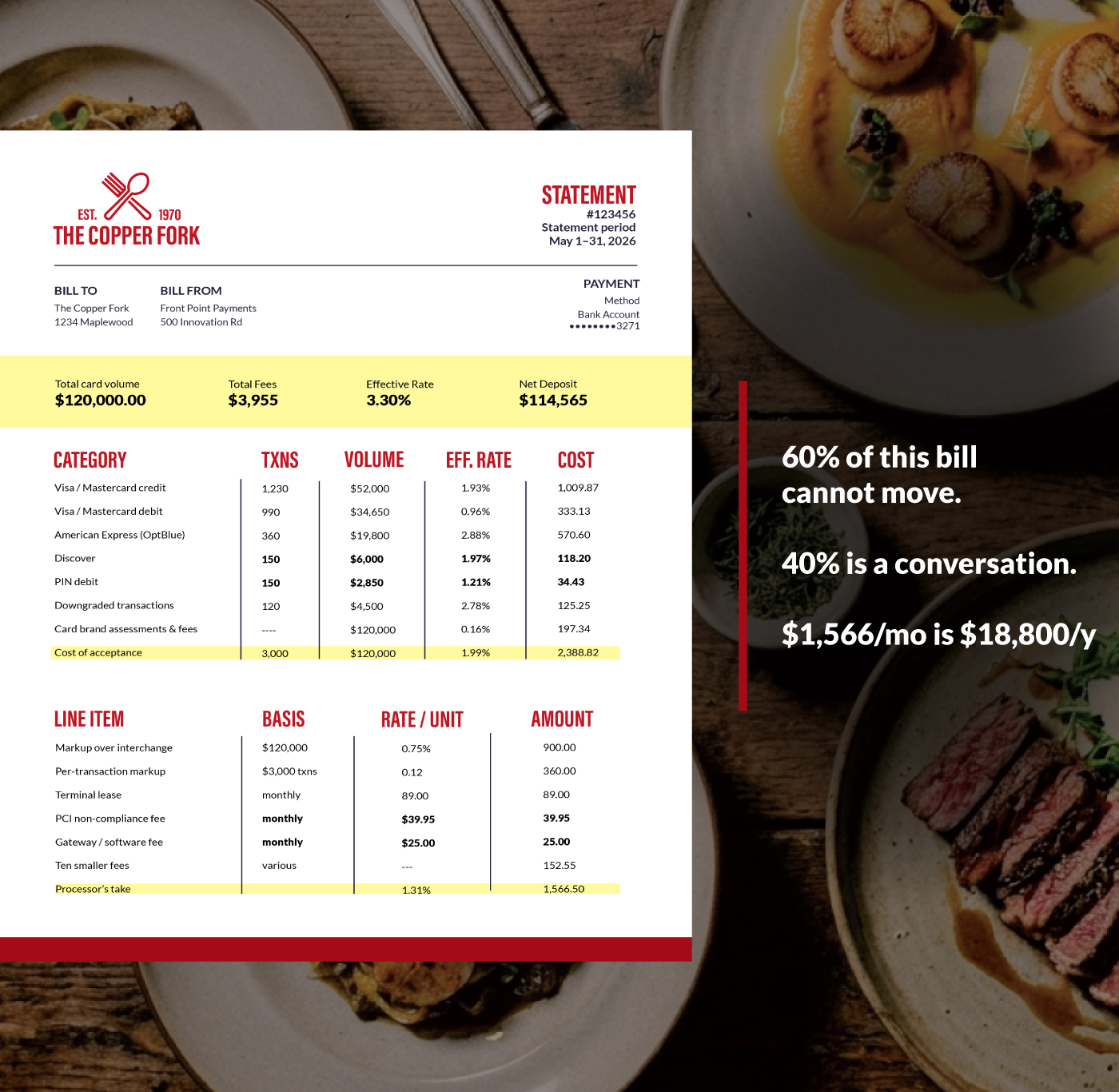
A big share of your bill is going to be fixed no matter which processor you use. Interchange is set by the card networks like Visa or Mastercard and paid to the bank that issued your guest's card. Assessments are the networks' own cut. All this to say, you’re not going to find savings there.
But you will find savings in the markup and the pile of monthly fees underneath it. That's the processor's own pricing, and it can be negotiated.
The most questionable charges are the easiest to miss, because they're buried in abbreviations. Open the PDF and use Ctrl-F (you’re going to want to be on a computer for this one). Search for terms "PCI," "batch," "statement," and "minimum." These junk fees often add up to $50 to $150 and fly under the radar:
Another to watch that isn't a line item: basis-point creep, where your rate quietly climbs after you sign. The easiest way to find this is to compare a statement from the same time last year.
One or two of these on their own won’t break the bank, but combined and added up over months or years, there’s real savings to be found.
There is not a “right rate,” because card mix and average ticket move the number around. As a working benchmark, most full-service restaurants land at an effective rate between 2.2% and 3.5%. Above 3% isn't proof you're being gouged, but it's a good reason to pull the markup and the tiers apart.
Most full-service restaurants land between 2% and 3.5%. Above 3% is worth a closer look — usually it means there's markup or a tier structure you can question.
For most restaurants doing real volume, interchange-plus comes out lower, because you can see and negotiate the markup instead of paying one blended rate. Flat rate is simpler to read, and you pay for that simplicity.
The processor markup, and some of the monthly fees. Interchange and assessments are pass-through costs set by the card networks, so no processor can lower them, whatever they promise.
Reading your statement is the fastest of the three numbers to check, and it's the one with real dollars attached. If you want a second set of eyes, send us last month's statement and we'll find your effective rate, spot your pricing model, and show you what's actually negotiable. No pitch, no switch required.