
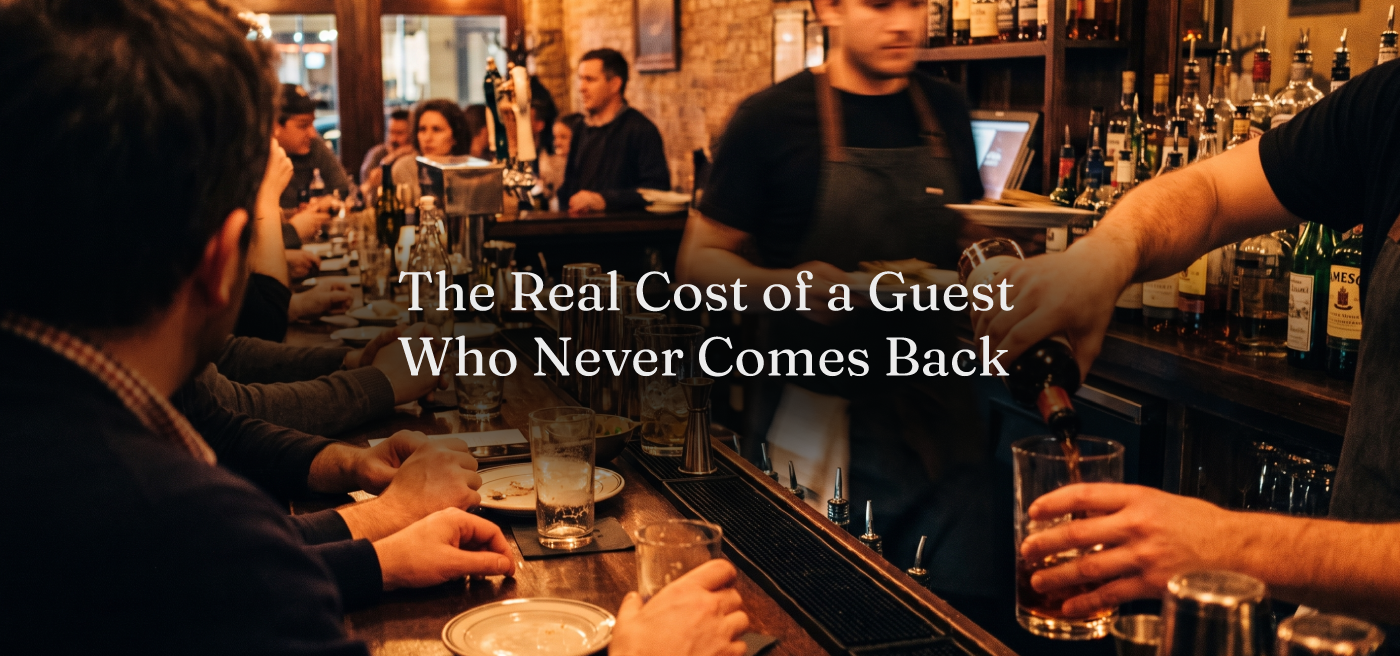
Your dining room was full last month. So why does the guest count on your reports look thinner than it feels?
Traffic has been broadly soft across the industry for well over a year. Per the National Restaurant Association's tracker, July 2026 marked the 17th net decline in customer traffic in the last 18 months — 40% of operators saw traffic rise, 49% saw it fall — even as sales held up on higher checks. You're not imagining it, and you're not alone.
Here's the part almost nobody's system shows them: the guests you already earned are worth far more than the ones you're chasing to replace them.
Every operator knows in theory that turning a guest into a regular is better than winning a new one. But few actually run the math themselves.
Harvard Business Review puts a number on it: acquiring a new customer typically costs five to twenty-five times more than keeping an existing one. Raise your retention rate by just 5%, and profit can climb anywhere from 25% to 95%. That's a cross-industry finding, not a restaurant-specific study. But add the restaurant layer, and the real value of a regular comes into focus. Bloom Intelligence, analyzing guest data across 1,000+ restaurant locations, puts a one-time visitor's average lifetime value at $26 — versus $685 for a regular, a 26× gap.
Paytronix's 2026 Loyalty Report finds a similar spread from a different guest base: guests with 10 or more visits carry roughly 27× the lifetime value of a one-timer.
Now put a guest count behind it. If replacing a lost regular costs five to twenty-five times more than it would have cost to keep them — and is worth roughly 26 to 27 times less over its lifetime — every regular who quietly stops coming back is an expensive, invisible line item. It never shows up on your P&L, because nothing tells you they're gone until you can't remember when you saw them last.
The highest-leverage moment in a guest's relationship with your restaurant is the second visit, not the first — and there's a number behind that now, not a hunch.
Per Paytronix's 2026 Loyalty Report, a guest's odds of returning sit under 50% after their first visit — but climb to 95% by their fourth. Most of that climb happens early: the second and third visits are where a guest goes from "might come back" to "basically will." That's the moment a stranger starts turning into a regular, and it's the moment almost no restaurant system is built to notice.
It also tracks with the retention economics above: if keeping a guest is worth five to twenty-five times what it costs to win a new one, the second and third visits are where that value actually starts accruing. Every regular you have today walked through that same door once, came back, then kept doing it. A handful of regulars do more work for your business than the rest of the room combined. Losing one of them isn't a rounding error.
Jon Taffer—of Bar Resure fame—has been making the same case to restaurant owners for years, minus the decimals: mark your first-timers, hand them a reason to come back a second time, reward the third visit. By the fourth, in his words, "you own them." His numbers are a practitioner's rule of thumb, not a sourced study. But the shape of the argument matches what Paytronix's curve backs up with data — the second and third visits are where a guest actually converts into a regular, and almost nothing in a typical restaurant's stack is watching for it.
Ask most owners for their repeat-guest rate and you'll get a shrug, not a number. The data to answer it usually lives in three different places that were never built to talk to each other — not because owners don't care.
Your payment system sees the card. Your POS sees the ticket. Your guest-data tool, if you have one, catches whatever a guest chose to hand over — an email, a phone number, a loyalty signup. None of the three, on its own, can tell you that the card that closed out table 12 tonight is the same card that closed out table 12 six weeks ago. So the question "how many of tonight's guests have we seen before?" goes unanswered, night after night, in a business where the answer is worth real money.
Whether a guest comes back is only half the question. Which dishes bring them back is the other half. Upserve's Menu Insights report connects the two: it ties every item on your menu to whether the guests who ordered it ever returned, something a register alone can't tell you. A dish everyone orders once and a dish that quietly builds regulars can look identical on a sales report and be worlds apart on a retention one.
.png)
It comes down to three unglamorous things done consistently, not a punch-card promotion:
Each one runs on knowing who's coming back, and who's started to drift, in time to do something about it — not on a loyalty app.
Retention is a discipline, not a switch you flip — a habit of noticing, not a one-time fix. It compounds the same way a slipping repeat rate erodes: slowly, invisibly, until the dining room feels quieter than it used to.
Traffic and pricing both have a ceiling. There's a limit to how many new guests are out there to win, and a limit to how much a check can grow before guests push back. How often the guests you already have come back doesn't have that ceiling. It's the lever most restaurants aren't pulling, mostly because nothing puts the number in front of them.
What's a good repeat-customer rate for a restaurant? There's no single industry-wide benchmark with solid methodology behind it — it depends heavily on concept, check average, and neighborhood. The more useful exercise is knowing your own number and watching the trend, since almost no system surfaces it by default.
How do I calculate my repeat rate? You need a way to recognize the same guest across visits — usually the card on file — and count how many of a given period's guests you'd already seen before. Most POS and payments systems, used separately, can't answer this on their own.
Are repeat guests really worth more? Yes. Per HBR/Reichheld, retaining a guest is far cheaper than replacing one, and small gains in retention translate into outsized gains in profit. Two restaurant-focused platforms put a number on the gap directly: Bloom Intelligence puts a regular's lifetime value at roughly 26× a one-timer's; Paytronix independently lands near 27×. The exact figure varies by concept — it's still worth knowing your own number instead of a borrowed one.
What's the fastest way to earn a second visit? Consistency and recognition, not a discount. The goal is giving a first-timer a specific reason to think of you again, not a coupon that trains them to wait for one.
Why doesn't my POS show retention? Because recognizing a repeat guest requires connecting payments, POS, and guest data — three systems most restaurants run separately, none of which was built to compare notes with the others.
Reading a merchant statement or costing a menu is math you can do with a calculator. Retention is different — it requires seeing across systems that were never built to talk to each other, which is exactly why most restaurants can't answer a question this important.